
Key Takeaways
- Sustainable store design starts at the fixture level, and for custom millwork, durability is the single biggest lever; fewer replacements mean less manufacturing, shipping, and waste.
- Well-built custom millwork can last decades, while cheap, mass-produced fixtures often fail within a few years, and every replacement cycle adds cost and environmental impact.
- Sourcing choices, including FSC and SFI certified wood, reclaimed materials, domestic species, and low-VOC finishes, reduce a millwork program’s footprint without sacrificing strength.
- Sourcing wood domestically in North America, rather than importing it overseas, cuts down on the emissions tied to long-distance shipping while often costing less.
- The same sustainable material choices that reduce environmental impact, like reclaimed wood and natural grain, also shape a store’s look, feel, and brand story.
Sustainable store design starts at the fixture level, and for custom millwork, durability is what keeps a store’s physical footprint out of landfills. Fewer replacements mean less manufacturing, less shipping, and less waste. The guide below covers what that looks like in practice, from why durability comes first to the material choices that support it.
Table of Contents
- What Does Sustainable Store Design Mean for Millwork?
- Why Durable Millwork Is the Most Sustainable Choice
- Sustainable Wood Sourcing for Custom Millwork
- How Sustainable Millwork Choices Shape a Store’s Look and Feel
- Partner With Agility Retail Group on Sustainable Millwork
- Frequently Asked Questions
What Does Sustainable Store Design Mean for Millwork?
Sustainable store design covers everything from energy use to packaging to supply chain, but at the fixture level, it comes down to how millwork is built: durable construction, responsible material choices, and design that lasts, rather than a single material swap or certification.
Sustainability at the store level touches energy use, packaging, supply chain, and more. This piece narrows in on one layer of that picture, the millwork itself. For the broader, all-materials view of sustainable tactics across a full fixture program, see our broader guide to sustainable store fixtures.
Here, the argument is more specific. Durability comes first, because a fixture that lasts avoids the replacement cycle that drives most of a program’s environmental impact. Material sourcing supports that durability rather than standing in as the main argument on its own, and the sections below cover both.
Why Durable Millwork Is the Most Sustainable Choice
Durability is sustainability. Well-built custom millwork can last decades, while cheap, mass-produced fixtures often fail within a few years, and every replacement cycle means more manufacturing, more shipping, and more waste. The most sustainable choice isn’t a certification; it’s a fixture that doesn’t need to be replaced.
- Eliminating the replacement cycle: commercial-grade construction, quality joinery, and refinishable surfaces mean a fixture can be repaired or refinished rather than torn out and landfilled, at a point when a cheaper alternative would already be worn out.
- Lower impact by nature of the material: wood is widely recognized in the building industry as a renewable material with lower embodied carbon than steel, concrete, or vinyl, since it requires less energy-intensive processing to manufacture.
- Long-term value: durable millwork avoids the recurring cost of repairs, maintenance, and premature replacement over a store’s lifespan. The longer a fixture stays in service, the more value it returns on what it took to design, build, and install in the first place, since that same investment never has to be made a second time.
Durability works best when it’s paired with the right sourcing and finishes from the start. This builds directly on the importance of durability and ROI covered in our guide to durable, long-lasting millwork.
Sustainable Wood Sourcing for Custom Millwork
The wood chosen for custom millwork determines more than its environmental footprint. It also determines how long the piece lasts, which is why sourcing and durability are connected decisions rather than separate ones. FSC-certified wood, reclaimed wood, and recycled-content panels can reduce impact without sacrificing the strength a high-traffic retail fixture needs.
- Certifications: look for wood verified by recognized standards like the Forest Stewardship Council (FSC) or the Sustainable Forestry Initiative (SFI). Both confirm responsible harvesting and forest management practices.
- Reclaimed and recycled-content materials: salvaged lumber and recycled-content engineered panels divert material from landfills and often bring unique character to feature pieces.
- Domestic and regional species: choosing domestic hardwoods over exotic imports reduces the transportation emissions tied to long-distance shipping. North America has substantial timber resources, and sourcing wood regionally rather than importing it overseas is both more cost-effective and lower-impact, since the material travels a fraction of the distance to reach the shop floor.
- Bamboo: technically a grass rather than a wood, bamboo is worth calling out on its own. It matures in three to five years rather than the decades a hardwood tree needs, regenerates from its own root system after harvest rather than requiring replanting and still offers the tensile strength to hold up to daily retail traffic. It’s one of the fastest-growing plants on earth, and it’s earned a place in sustainable millwork conversations even though it sits outside the traditional wood category.
- Panel substrates: for cabinet boxes and paneling, specifying formaldehyde-free (NAUF) plywood or MDF supports indoor air quality alongside the visible wood choice.
- Finishes: low-VOC or zero-VOC stains and finishes complement the material choice without introducing the off-gassing associated with conventional lacquers.
Designing for a longer life also means designing for adaptability, since modular millwork that gets reconfigured rather than torn out reduces waste during a store refresh, a concept our guide to maximizing retail space covers in more depth.
For the full range of materials used across Agility Retail Group’s fixtures and millwork, beyond the sustainability-specific choices covered here, see our guide to retail fixture materials.
How Sustainable Millwork Choices Shape a Store’s Look and Feel
The same wood choices that reduce environmental impact, reclaimed wood, natural grain, FSC-certified species, also shape how a store looks and feels. Sustainable material choices aren’t separate from a store’s design, they’re part of it, adding warmth, texture, and a sense of intention that generic materials don’t.
Natural wood grain, texture, and organic materials soften the look of a retail space compared to synthetic or mass-produced surfaces, a sensory, visible effect a shopper notices without necessarily knowing why. Reclaimed or characterful wood carries a visible history, unique grain, weathering, and texture variation, that signals a store made a deliberate, considered choice rather than defaulting to the cheapest option available. That signal matters to shoppers who notice or care about sustainability, and it reinforces brand credibility in a way a generic laminate surface can’t.
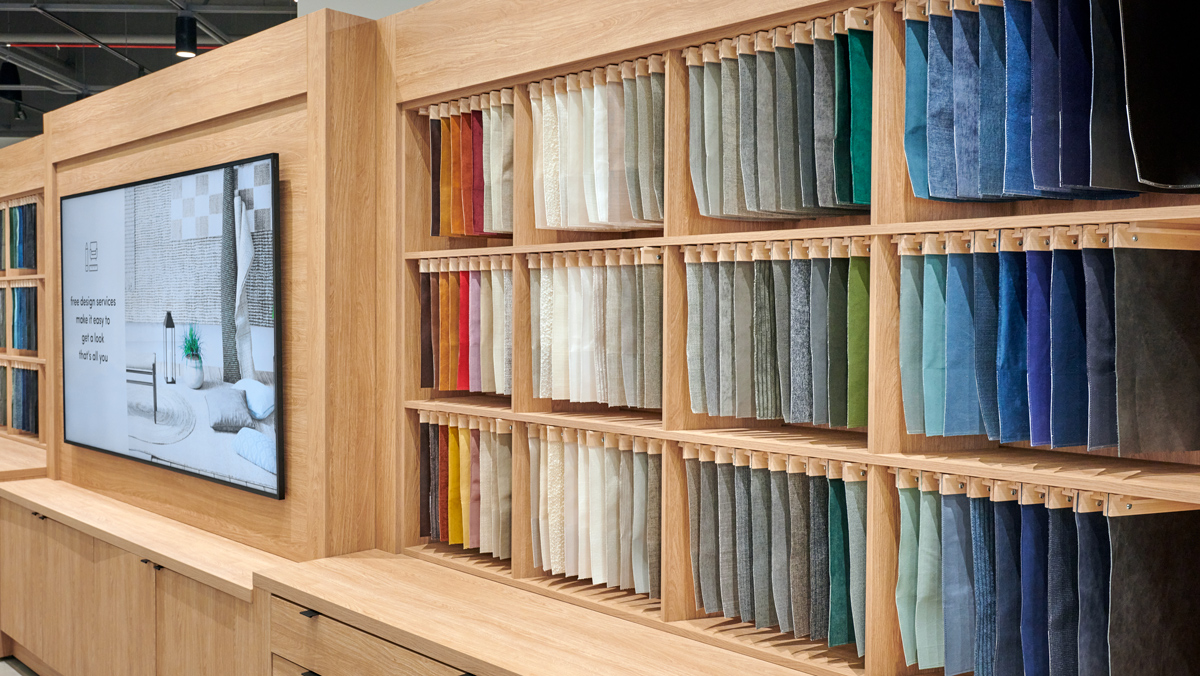
Agility Retail Group’s work with Wayfair is a clear example. The fixtures, millwork, and décor across Wayfair’s large-format stores were built using an eco-friendly, custom species the two companies came to call “Wayfair Oak,” carrying the same sustainable material story from the structural fixtures through to the finishing details. These same material and finish choices are also the starting point for a store’s broader décor and environment, from wall and ceiling treatments to feature displays, which is its own discipline built on the same foundation of intentional materials.
Partner With Agility Retail Group on Sustainable Millwork
Durability and responsible sourcing are a business decision as much as an environmental one. Fewer replacements, lower lifecycle cost, and a credible answer for ESG-minded retail partners all come from the same set of choices covered above.
Value engineering plays directly into this too. Small adjustments made during design, changing a panel dimension by a fraction of an inch to get a better yield out of a sheet of wood, or specifying a different substrate for a piece that doesn’t need premium hardwood, reduce material waste and cost at the same time. It’s one of the reasons Agility Retail Group’s in-house design and engineering team gets involved early in a program, since those decisions are far easier to make on paper than after a fixture is already built.
Talk to Agility Retail Group about building millwork that lasts. Connect with our team to design a sustainable millwork program built for the long term.
Frequently Asked Questions
Can eco-friendly millwork withstand high-traffic retail environments?
Yes. Sustainable millwork, built with responsibly sourced wood, recycled-content panels, and commercial-grade finishes, can match or exceed the durability of traditional fixtures. Sustainability and performance aren’t a tradeoff. The same construction quality that makes a fixture durable is what keeps it out of the replacement cycle in the first place.
Does sustainable retail millwork cost significantly more?
Not necessarily. Certain materials, like certified or reclaimed wood, can carry a modest premium, but durability offsets that over time, since a fixture that lasts twice as long costs less over its lifespan even if the upfront price is somewhat higher. The real comparison is lifecycle cost rather than sticker price, and a project-specific quote is the only way to know for sure, since cost varies by material, scope, and design.
How does sustainable millwork improve indoor air quality?
Sustainable millwork improves indoor air quality primarily through the materials and finishes used. Formaldehyde-free (NAUF) panels and low- or zero-VOC finishes avoid the chemical off-gassing associated with conventional particleboard and standard lacquers, creating a healthier environment for staff and shoppers alike.
How does sustainability affect lead times for rollouts?
Sourcing certified or reclaimed wood can sometimes take longer than standard stock materials, since it isn’t always immediately available in the volume a rollout needs. The way to manage this is the same principle that applies to any custom millwork program: specify materials and finalize designs early. Our guide to custom retail millwork lead times covers that planning process in more depth.