
Key Takeaways
- Store fixture material selection directly impacts durability, lead times, cost, brand presentation, and long-term retail performance.
- Most successful fixture programs combine multiple material types such as wood, metal, glass, and solid surface to balance aesthetics, functionality, and durability.
- Wood fixtures offer the widest range of aesthetic flexibility, while metal and wire fixtures excel in high-traffic, load-bearing retail environments.
- Solid surface, glass, and acrylic materials are commonly used for premium retail displays, counters, and high-visibility merchandising applications.
- Choosing the right store fixture materials requires evaluating merchandise needs, store environment, brand aesthetics, sustainability goals, durability expectations, and overall program economics.
Material selection is one of the earliest and most consequential decisions in a store fixture program. It affects cost, lead time, durability, brand presentation, and how the fixture performs in the specific retail environment it will live in. The right material is the one that fits the merchandise, the environment, the brand, and the production requirements of the program.
Most custom store fixture programs combine two or more material families to achieve the best results. A wood millwork environment might incorporate metal structural elements, glass display cases, and solid surface counters to balance aesthetics with high-traffic functionality. This guide covers the primary material families — wood, metal, solid surface, glass, and plastic — and how most programs integrate them to create a cohesive brand story.
Table of Contents
- Wood Store Fixtures
- Metal and Wire Store Fixtures
- Solid Surface Store Fixtures
- Glass Store Fixtures
- Plastic and Acrylic Store Fixtures
- How to Choose Store Fixture Materials
- FAQs
Wood Store Fixtures
Wood is one of the most widely used materials in fixture programs across retail verticals because it offers warmth, finish versatility, and the broadest range of aesthetic outcomes. In a professional fixture program, wood refers to a family of engineered and natural materials, each suited to different applications and budget levels. Agility Retail maintains extensive in-house wood manufacturing capability to support these programs, including CNC routing for precise panel processing, laminating, edge banding, dedicated spray booths for custom finishing, and a suite of tools for cutting, planing, and boring.
Wood Material Comparison
| Material | What It Is | Why Use It | Where It Works Best |
| MDF | Dense, smooth engineered panel made from wood fiber and resin. | Industry standard for painted/laminated fixtures; maintains shape; cost-effective. | Cash wraps, shelving panels, and large production runs. |
| Plywood | Layered wood veneer panels bonded under pressure. | Stronger than MDF with better fastener grip; lighter weight for shipping. | Structural backboards, load-bearing applications, and knock-down construction. |
| Solid Wood | Natural lumber (pine, oak, ash, maple), milled and finished. | Premium feel; natural grain and warmth communicate brand authenticity. | Boutique apparel, specialty food, and health and wellness environments. |
| Bamboo | Fast-growing, renewable grass processed into panels and boards. | Sustainable story; dimensionally stable; hard and durable. | Eco-conscious brands, natural food, and wellness retail. |
MDF (Medium Density Fiberboard) Store Fixtures
MDF is the industry standard base material for painted and laminated fixtures because its smooth, consistent surface is the ideal priority for paint, laminate, or direct print. It is processed efficiently via CNC router at scale and is generally more cost-effective than plywood or solid wood, even for smaller production runs. Critically, MDF tends to maintain its shape and does not bend or curve (expand/contract) in hot weather, making it highly stable. However, it should be avoided in high-moisture environments where the fibers may swell.
Plywood Store Fixtures
Plywood consists of layered wood veneer panels bonded under pressure, offering superior strength compared to MDF and a much better fastener grip. Because it is lighter in weight, it is often specified for programs where knock-down construction and shipping efficiency are priorities. Birch plywood is the most common specification in Agility Retail’s project history for applications such as structural backboards and load-bearing units. It is less suitable when a wide range of custom paint colors is required, as its finish options are more limited than MDF.
Solid Wood Store Fixtures
Solid wood refers to natural lumber such as pine, oak, ash, and maple, which are milled and finished specifically for fixture use. It is categorized into hardwoods and softwoods, with further aesthetic differentiation available through cuts like rift-cut or plain-slice oak. This material is the choice for premium retail environments where natural grain and warmth are central to the brand’s story, such as boutique apparel or specialty food. Trade-offs include the highest cost in the wood family and natural variations that make it difficult to achieve absolute consistency in high-volume production runs.
Bamboo Store Fixtures
Bamboo is a fast-growing grass that serves as the fastest-growing plant on earth, making it a powerful visual story for brands with sustainability commitments. It is dimensionally stable, hard, and renewable. It is the primary choice for wellness and eco-conscious retail, though it may not be ideal for programs where budget is the primary constraint or where a wide finish range is required.
Metal and Wire Store Fixtures
Metal plays a dual role in fixture programs as the structural backbone that carries load and defines architecture, and as wire construction that delivers open visibility, airflow, and cost efficiency. Metal in fixtures almost always means steel, which is almost always finished and frequently combined with other materials. Wire is not a separate material but a distinct construction method that unlocks properties that no other approach delivers the same way.
Steel — The Dominant Metal in Fixture Programs
Steel is the primary metal in fixture programs, used for everything from gondola-style shelving and racking systems to structural components within mixed-material fixtures.
- Finish is not optional: Powder coating is the standard specification because it protects against rust and scratches while allowing for precise brand color matching via PMS matching.
- Specialty finishes: Brushed, polished, blackened steel, clear coat, and brushed brass are increasingly specified in boutique and specialty retail to create a premium design effect.
- Stainless steel: Rust-resistant and well-suited for high-moisture environments and outdoor applications. While more expensive than standard sheet metal, it is the right spec for long-term durability in challenging environments.
- Aluminum: Lighter than steel and naturally corrosion-resistant; aluminum is available with premium anodized finishes. It is less common in permanent fixture programs but highly relevant for modular or mobile display applications.
Wire Construction
Wire construction involves fixture structures built from welded or formed steel wire that is then chrome-plated or powder-coated. This is a distinct construction method from fabricated sheet metal, defined by its open structure, full product visibility from multiple angles, airflow, and lightweight flexibility.
- When to use wire: Use wire for produce and fresh food displays where airflow is a functional requirement, and for accessory racks or grab-and-go counter merchandisers where visibility is key. It is also ideal for bulk bin displays and cost-sensitive freestanding units.
- When not to use wire: Avoid wire in premium brand environments where the fixture itself must be a brand statement. Wire reads as utilitarian and can be a liability in high-end contexts.
- Combination use: Wire is frequently paired with other materials, such as a wood base with a wire upper, or a metal frame with wire shelving inserts.
- Cost and logistics: Wire is among the most cost-efficient materials in the toolkit. It ships compactly, often in knock-down construction, with a lower per-unit cost than fabricated sheet metal.
Metal is best for high-traffic environments and programs where load capacity is a priority, such as grocery and big box stores. Agility Retail has domestic, in-house metal fabrication capability but also utilizes a blended manufacturing model. By fabricating metal overseas to leverage raw material advantages and manufacturing wood domestically, Agility Retail puts each material where it is most efficiently produced.
Solid Surface Store Fixtures
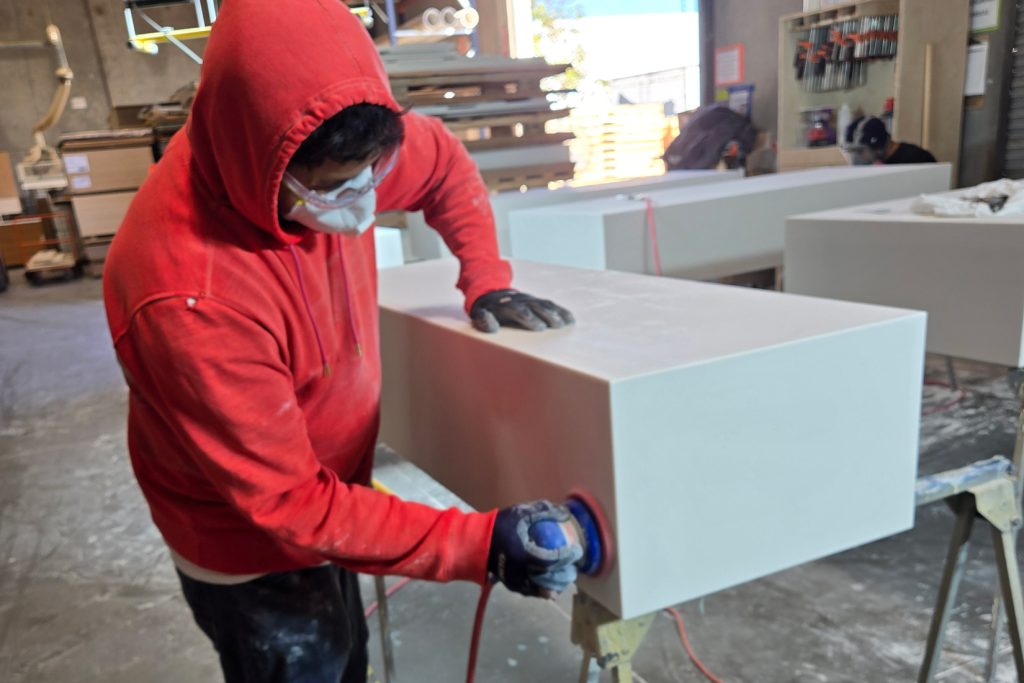
Solid surface does what no other material matches: it is seamless, non-porous, fully repairable, and available in hundreds of colors and patterns. It is the material of choice when hygiene, a premium finish, and long-term durability must coexist in the same fixture.
- What it is: An acrylic or polyester-based material that is homogeneous through its thickness and thermoformable.
- Primary use cases: Cash wraps, beauty and pharmacy counters, food service counters, and fitting room surfaces.
- Key advantages: No visible seams when fabricated correctly. Scratches and minor damage can be sanded and repaired in the field.
- Durability and ROI: Cash wraps made of wood with laminate finishes eventually chip and look poor. While solid surface may be more expensive initially, it looks better over the long haul, needs replacing far less often, and generally offers a better ROI.
- Verticals: Most common in health and beauty, grocery, drug, QSR, and department store beauty counters.
Glass Store Fixtures
Glass is the only fixture material that makes merchandise fully visible from multiple angles while simultaneously communicating security and premium positioning. While clear acrylic can achieve a similar visibility effect, glass remains the standard for high-end retail.
- What it is: Tempered glass is the standard specification for retail use. It is significantly stronger than standard glass and is designed to break safely if it fails.
- Primary use cases: Display cases for high-value merchandise like jewelry and electronics, glass shelving in wall systems, and sneeze guards in food service.
- Mixed-material use: Glass is rarely the primary structural material. It is almost always integrated with a metal frame, wood cabinetry, or a solid surface component.
- Lighting integration: Glass fixtures are frequently designed with integrated LED lighting to maximize product visibility and create a premium effect.
- When not to use glass: Avoid glass in high-traffic environments where impact risk is elevated or in programs with aggressive shipping schedules where breakage risk increases.
Plastic and Acrylic Store Fixtures
Plastic and acrylic offer transparency, lightweight versatility, and the ability to make the product the visual focus rather than the fixture itself. Acrylic (plexiglass) is the dominant plastic in custom programs.
- What it is: Clear, lightweight material available in a range of colors. Agility Retail has in-house plastic manufacturing capabilities.
- When to use acrylic: Use it for risers and pedestals to elevate products, jewelry, and cosmetics cases where full visibility is the priority.
- Recycled acrylic: Agility Retail has used recycled acrylic in programs like Guayaki’s POP display program, maintaining the clarity of virgin acrylic while meeting sustainability goals.
- Vacuum-forming: Vacuum-formed plastic is within Agility Retail’s overseas capabilities and is common in the beauty industry for dimensional signage and specialized trays.
How to Choose Store Fixture Materials
Selecting materials requires a sequential logic to ensure the best outcome for the program lifecycle.
- Start with the merchandise: Consider the weight of the product, security needs, and whether visibility from multiple angles is required. Requirements here eliminate the wrong choices immediately.
- Consider the store environment: High-traffic areas demand high durability. Moisture-adjacent environments in grocery or food service require non-porous materials like solid surface rather than MDF.
- Match the brand aesthetic: Wood suggests warmth, metal suggests an industrial aesthetic, solid surface reads as premium and seamless, and acrylic works best when it “disappears”.
- Think about the full program lifecycle: Consider how long the fixture must last and if it can be repaired in the field. Solid surface and metal are the most durable long-term investments.
- Sustainability requirements: Material selection is a key lever for sustainability. Options include bamboo, recycled acrylic, reclaimed wood, and recycled metal.
- Evaluate the economics: Design must be economically feasible. Material yields (how dimensions intersect with standard 4×8 sheet goods) are a key determinant of cost-effectiveness.
A well-designed fixture program uses each material where it performs best. The right manufacturing partner has in-house capability across all of them to ensure quality, cost control, and a seamless brand environment.
Ready to build fixtures that perform as well as they look?
Whether you’re launching a new retail concept, rolling out hundreds of stores, or upgrading an existing environment, Agility Retail delivers custom fixture programs engineered for durability, brand impact, and scalable production. Learn more about successfully rolling out a store here.
Talk with our team to find the right material strategy for your next project and bring your retail vision to life.
FAQs
What is the most durable material for store fixtures?
Durability is application-specific. For structural load-bearing in high-traffic areas, powder-coated steel is best. For counter surfaces, solid surface is the most durable. For secure display cases, tempered glass or polycarbonate is the right spec.
How do material choices affect retail store aesthetics?
Materials communicate brand positioning before a customer reads a sign. Wood signals warmth and authenticity, metal signals modernity and precision, and solid surface reads as seamless and premium. Glass elevates what it displays, while wire reads as open and utilitarian.
Do material choices affect how long a store fixture program takes to produce?
Yes. Engineered wood processed via CNC is highly efficient. Solid wood and solid surface require more skilled fabrication time per unit. Custom glass elements often have longer lead times and less flexibility for last-minute changes. Locking in specs early is the most effective way to protect the production timeline.